
Setting the Lesson Goal & Identifying Needs
Learn how to turn a broad lesson topic into a meaningful pupil-centred goal and identify the specific skills that need development.
The Purpose of the Part 3 Lesson
Student-Centred Lesson Goal
The point of the ADI Part 3 is to deliver a lesson that helps the pupil make progress based on their goals and needs.
It is not simply about teaching a general topic. A good lesson focuses on a specific skill within a topic rather than covering it too broadly.
From Broad to Specific
A broad topic can provide the setting for a lesson, but it does not necessarily identify what the pupil actually needs to improve.
Clear Goal or Vague Goal?
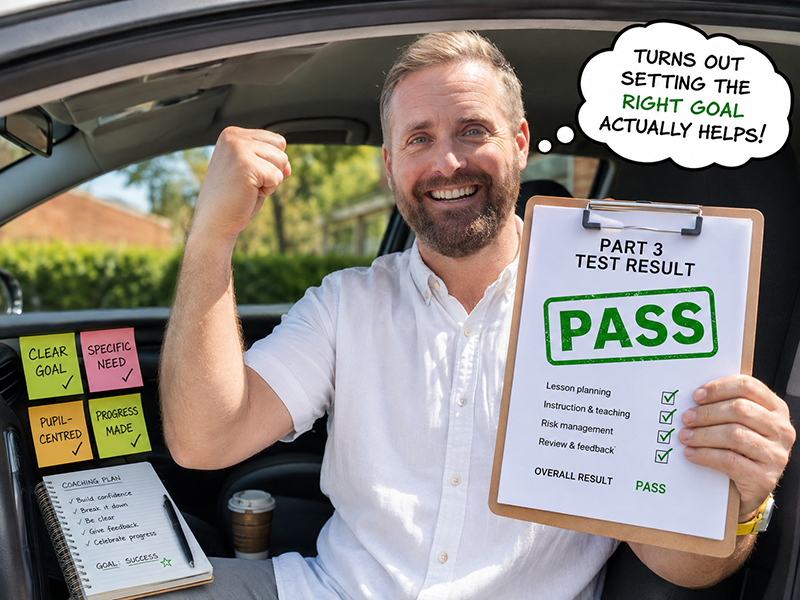
Clear & Specific
A focused lesson goal gives the pupil and instructor something meaningful to work towards and makes progress easier to recognise.

Too Broad & Vague
A goal such as “drive better” gives very little direction. The instructor needs to identify the specific skill that actually needs development.
Identifying the Specific Skill
Specific Skills to Focus On
Instead of treating the whole topic as the lesson goal, identify the individual skill or decision that needs development.
- Speed on approach to junctions
- Judging safe gaps when emerging
- Lane choice and timing of signals
- Mirrors before position changes
- Keeping the car moving in slow traffic
- Recognising when more time is needed to assess a situation
Identifying the Pupil’s Needs
Diagnosing Specific Issues
A pupil might say they struggle with “roundabouts”, but the instructor needs to identify exactly where the difficulty is occurring.
- Approaching the junction too quickly
- Not looking early enough
- Struggling to judge safe gaps
- Choosing the incorrect lane
- Signalling too early or too late
- Hesitating or rushing under pressure
Look Beyond the Topic
“Roundabouts” might be what the pupil notices, but the real learning need may be speed, observation, judgement, positioning or decision-making.
Using MSPSL & LADA
MSPSL: Key Physical Stages
MSPSL can help break the driving task into structured physical stages and identify where the pupil’s routine is breaking down.
For example, the difficulty may not be “the roundabout”. It may be that the pupil reaches the Speed or Look stage too late.
LADA: Cognitive Process
LADA can help the instructor explore the pupil’s real-time decision-making rather than concentrating only on the physical routine.
This can help identify whether the pupil is seeing the information, understanding what it means, making an appropriate decision and acting on that decision at the right time.
Topic → Need → Goal
A useful way to think about lesson planning is to move through three stages:
- Identify the topic — for example, roundabouts. Roundabouts are the area being practised, not the lesson goal itself.
- Diagnose the pupil’s actual learning need — break the topic down and identify what needs to improve. This could include approach speed, mirror use, planning, lane choice, judgement, positioning, timing or gap selection.
- Agree a specific lesson goal — for example, improve approach speed and earlier planning so the pupil has more time to observe, assess traffic and make safe decisions.

What Would a Good Coach Do?
“I want to do roundabouts today.”
You begin discussing the lesson and discover that the pupil has already practised several roundabouts successfully. However, they are still approaching too quickly and often need prompting to plan early enough.
Before You Move On
Think about one of your recent lessons. What was the topic, and what was the specific skill the pupil actually needed to improve?
Could you describe that lesson goal in one clear sentence that explains what progress you wanted the pupil to make?
↑ Back to top