
Roles, Responsibilities & the Job Share
Learn how to agree clear roles, match the level of support to the pupil, and create a job share that keeps the lesson safe, structured and purposeful.
What Did You Come Up With?
At the end of Lesson 1, you were asked to think about one of your recent lessons and identify the specific skill the pupil actually needed to improve.
You were also asked whether you could describe that lesson goal in one clear sentence.
What did you come up with?
Keep that pupil and lesson goal in mind as you work through this lesson. Once you know what the pupil needs to improve, the next question is how much responsibility they are ready to take and what support you need to provide.
Agreeing Roles & Responsibilities
Match the Support to the Pupil
Once the instructor understands the pupil’s needs, they should agree how much help the pupil will receive and how much responsibility they are ready to take.
The level of support should match the pupil’s ability, confidence and the risk of the driving situation.
Why the Agreement Matters
The pupil should know what they are expected to do and what help the instructor will provide.
This creates a clearer learning environment and prevents the instructor from either over-helping or leaving the pupil unsupported.
The Three Levels of Instruction
1. Full Talk-Through
The instructor gives clear step-by-step guidance and takes a high level of responsibility for helping the pupil through the task.
2. Prompting
The instructor uses questions, cues or short reminders to help the pupil think and make decisions while still receiving support.
3. Independent Practice
The pupil performs the task with little or no help, while the instructor continues to monitor the situation and remains responsible for safety.
The Direction of Travel
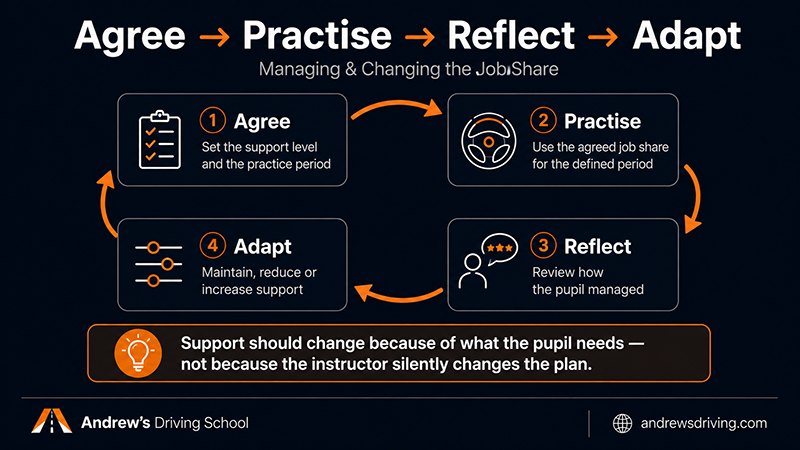
The aim is not to keep the pupil at one level indefinitely. Support should move towards greater independence when the pupil is ready.
Agreeing the Job Share Before Practice
Agree the Support
Before the practice starts, the instructor should agree the level of support with the pupil.
This should be specific to the lesson goal so there is absolute clarity about who is responsible for what.
In-Practice Example
“For the next few junctions, your job is to identify the junction early, start reducing speed… My job is to watch and give prompts… If there is any safety issue, I’ll step in.”
Notice how the agreement links directly to the lesson goal rather than simply saying that the instructor will “help”.

What Would a Good Coach Do?
You have agreed that the pupil will deal with observations and decision-making at junctions, while you will step in if safety begins to deteriorate.
A few minutes later, the pupil starts hesitating badly and repeatedly looks to you for confirmation before making decisions.
What Should the Pupil Understand?
A clear job-share agreement should tell the pupil four things:
- What they are working on
- What decisions they are responsible for
- What support the instructor will provide
- When that support will be reviewed
A Clear Job-Share Agreement
Too Vague
The pupil does not know what support to expect, what decisions they should make themselves, or when the instructor intends to step in.
Clear & Specific
The roles, support level and review point are all clear.
Before You Move On
Think about one of your recent lessons. Did your pupil know exactly what they were responsible for and what support you had agreed to provide?
If you had simply said “I’ll help if needed”, how could you make that agreement more specific next time?
↑ Back to top