
The Three Levels of Support
Understand how full talk-through, prompting and independent practice work together to move the pupil towards greater responsibility and independence.
How Did You Manage the Change?
At the end of Lesson 3, you were asked to think about a lesson where you increased or reduced your level of support.
Did you explain that change to the pupil, or did the amount of help simply change as the lesson progressed?
What did you come up with?
You were also asked how you could build a clearer review point into the lesson. Keep that example in mind as we now look more closely at the different levels of support available to you.
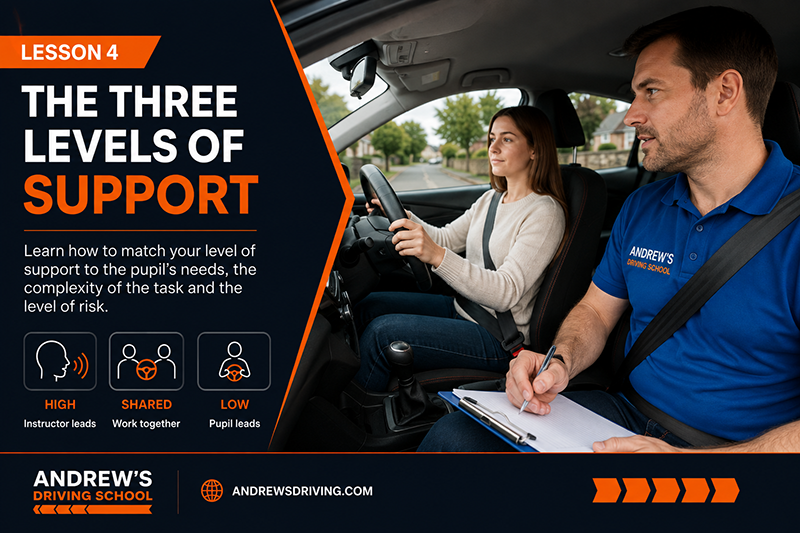
Three Levels, One Direction
The level of support should match the pupil’s ability, confidence and the risk of the driving situation.
The instructor can move between three broad levels of instruction:
- Full Talk-Through — instructor guides step-by-step.
- Prompting — instructor uses questions or cues.
- Independent Practice — pupil performs with little or no help.
Full Talk-Through
Overview & Application
The instructor gives clear, step-by-step guidance before and during the task.
When to Use
- The pupil is brand new to a subject
- The pupil feels unsure or nervous
- The pupil cannot yet manage the situation independently
Example: Roundabout Approach
“Check your mirrors. Signal right. Move into the right-hand lane. Start easing off the gas now. Cover the brake. Look early to the right. Keep the car moving slowly. There is traffic coming, so hold back. Now it’s clear… Prepare to move. Go now… Exit safely.”
Key Benefits
- Provides a clear, predictable model to follow
- Reduces uncertainty and anxiety
- Helps the pupil map out the correct sequence
Check Your Understanding
Question 1
A pupil understands the basic routine but still needs occasional help with timing and decision-making. Which level of support is most appropriate?
Question 2
What is the main purpose of independent practice?
Question 3
A pupil begins to struggle during independent practice. What should the instructor do?
Question 4
Which statement best describes the purpose of prompting?
Prompting
Overview & Application
Prompting sits between full instruction and independence and is often the most difficult level for instructors to master.
It allows the pupil to think and make decisions while receiving support only where necessary.
Active Questioning
Instead of dictating actions, use questions to prompt memory and decision-making:
- “What mirrors do you need?”
- “How is your speed on approach?”
- “Is it safe to go?”
Short Reminders
Condense guidance into short cues that trigger pupil action:
Independent Practice
Overview & Importance
Independent practice is where the pupil carries out the task with little or no help from the instructor.
This is essential because the pupil needs to become a safe driver without relying on the instructor’s support.
In-Practice Example
“On the next few junctions, I’m going to let you deal with the approach and decision-making yourself. I’ll only step in if I need to for safety.”
Key Responsibilities
- Give the pupil the chance to apply the skill without support
- Watch carefully and remain responsible for safety
- Be ready to intervene if the situation becomes unsafe or the pupil is not coping
Moving Between the Levels
Reduce Support When Ready
As the pupil improves, the instructor should reduce the level of help and allow them to take more responsibility.
Increase Support When Needed
If the pupil begins to struggle or the situation becomes unsafe, the instructor may need to increase the level of support again.
Support Should Build Independence
The three levels are not separate teaching styles. They are different amounts of support that can be adjusted throughout the lesson.
The instructor’s job is to recognise how much help the pupil needs, provide that support clearly, and reduce it when the pupil is ready.
Before You Move On
Think about a recent pupil. Which of the three support levels were you using most often?
Were there opportunities to reduce the help sooner, or moments where the pupil actually needed more support?
↑ Back to top