
Key Points & Knowledge Check
Bring together the key principles from the course, review how they connect during a real lesson, and check whether you can apply them in practice.
How Would You Handle It Differently?
At the end of Lesson 9, you were asked to think about a lesson where you had to intervene verbally or physically for safety.
You were asked whether your explanation afterwards helped the pupil understand why you stepped in, or whether it mainly focused on what they had done wrong.
What did you come up with?
Keep that example in mind as you work through this final Module. It brings together many of the skills we have covered: identifying the learning need, agreeing responsibility, choosing the right support, managing risk, reflecting and adapting.
The Big Picture
Throughout these modules, we have looked at lesson goals, roles and responsibilities, job share, prompting, adaptation, reflection and independence.
In a real lesson, these things do not happen separately. They continually influence one another.
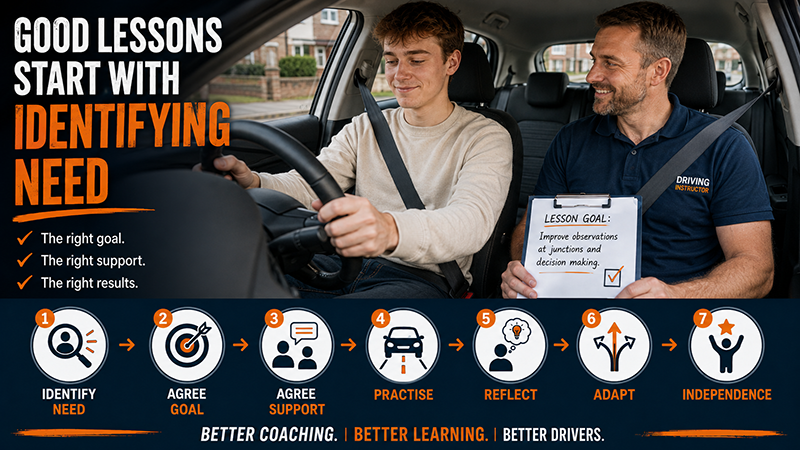
Identifying the learner’s need is only the starting point. Once the goal is clear, the rest of the lesson should flow from it: the level of support, the practice chosen, the way progress is reviewed and the point at which responsibility is handed back to the pupil.

Set the Lesson Up Properly
Start With the Real Learning Need
Avoid building the lesson around a broad subject such as “roundabouts” or “junctions”.
Identify the specific skill that needs development and agree a clear goal with the pupil.
Agree the Job Share
Make sure the pupil understands:
- What they are working on
- What decisions they are responsible for
- What support you will provide
- When that support will be reviewed
Weak Agreement
Clear Agreement
Keep Assessing the Lesson
Once practice begins, continue assessing what is happening rather than following the original plan regardless of the pupil’s performance.
Watch the Driving
- Is the pupil applying the skill?
- Are faults beginning to repeat?
- Is the level of risk changing?
- Is the pupil becoming more or less confident?
Watch the Learning
- Are your prompts actually helping?
- Is the pupil thinking or just following instructions?
- Are you analysing faults rather than merely mentioning them?
- Has the pupil had a chance to try independently?
Give the Right Amount of Support
Too Much Support
Over-instruction can keep the drive looking controlled while preventing the pupil from making decisions.
This often happens when prompting quietly turns back into a step-by-step talk-through.
Too Little Support
Independence should not mean allowing a pupil to struggle without the help they currently need.
Increase support when learning, confidence or safety requires it.
The Question to Keep Asking
The answer may change several times during one lesson.
Can the Pupil Demonstrate Learning?
Guided Performance
A pupil may complete a task successfully while receiving frequent prompts from the instructor.
That tells you they can perform the task with support, but it does not necessarily prove they can manage it independently.
Independent Application
At the appropriate point, reduce the support and give the pupil a real opportunity to recognise the situation, make the decision and carry out the task themselves.
Questions to Ask Yourself During the Lesson
1. Core Lesson Setup
- Have we agreed a clear goal?
- Is the lesson focused on a skill rather than just a topic?
- Does the pupil understand their job?
- Does the pupil understand my job?
- Is the level of support clear?
- Am I keeping to the agreed support until we review it?
2. Active Lesson Delivery
- Am I prompting, or have I slipped into talk-through?
- Are my prompts early enough to help?
- Am I watching the pupil as well as the road?
- Have I analysed the fault rather than just mentioned it?
- Have I reviewed whether learning is taking place?
- Have I given the pupil a chance to show independence?
The Ultimate Self-Check
Common Problems to Avoid
Unstructured Lesson
The lesson lacks a clear learning focus and faults are mentioned without proper analysis.
Mismatched Support
The level of instruction does not match the pupil’s actual ability, confidence or needs.
Over-Instructing
Light prompting is agreed, but the instructor gradually starts talking the pupil through every stage.
No Pupil Ownership
The pupil is never given enough responsibility to demonstrate what they can actually do.
Can You Join the Dots?
Before taking the Section 1 Knowledge Check, use these questions to review the key decisions an instructor needs to make during a real lesson.
Question 1
A pupil says they want to work on roundabouts. What should the instructor do before deciding the lesson goal?
Question 2
What is the main purpose of agreeing a job share?
Question 3
A pupil understands the skill but still needs help recognising when to act. Which approach is likely to support their thinking best?
Question 4
The pupil improves significantly during practice. What should happen to the level of support?
Question 5
A pupil becomes less consistent when traffic gets busier. What should the instructor do?
Question 6
Why are light or reflective prompts useful with a more capable pupil?
Question 7
When should the instructor intervene for safety?
Question 8
What gives the strongest evidence that learning has taken place?
Question 9
What should reflection lead to?
Question 10
Which question is the strongest overall self-check for the instructor?

What Would a Good Coach Do?
Your pupil’s goal is to improve planning and approach speed at junctions. You agreed that they would manage the approach independently and you would only use light prompts if needed.
The first few junctions go well. As traffic becomes busier, however, the pupil begins approaching too quickly, their observations become rushed and they need increasing help.
Take This Into Your Next Lesson
Think about your next real pupil lesson.
What is one thing from this course that you are going to deliberately do differently?
It might be making the lesson goal more specific, agreeing the job share more clearly, prompting earlier, asking better questions, reducing support sooner or creating a clearer opportunity for independent practice.
Choose one change and look for evidence during the lesson that it has improved the pupil’s learning.
↑ Back to top