
Adapting Prompts to the Pupil
Learn how to adapt the type, timing and level of prompting to suit the individual pupil, their experience, confidence and what is happening in the driving situation.
Was the Prompt Right for That Pupil?
At the end of Module 6, you were asked to think about a prompt you use and decide whether it was direct, guided, light or reflective.
More importantly, you were asked whether that level of support was right for the pupil at that particular moment.
What did you decide?
A prompt can be perfectly reasonable for one pupil and completely wrong for another. Even the same pupil may need a different style of support from one situation to the next.
Every Pupil Is Different
Adapt the Support, Not the Pupil
Pupils respond differently to instruction. Some may benefit from a short verbal cue, while others may respond better to a question, visual cue or a little more time to process the situation.
The instructor should adapt their teaching style rather than assuming one prompting method will work for everyone.
What Might Affect Your Choice?
- The pupil’s experience
- Their current level of ability
- Their confidence
- How well they understand the skill
- The level of risk in the situation
- How much mental capacity they have at that moment
Prompting a Partly Trained Pupil
They May Still Need Structure
A partly trained pupil may understand some of the task but still need active prompts to reinforce the basic routine and help them remember what comes next.
At this stage, the instructor may need to be more active because the skill is not yet secure.
Example Prompts
- “What comes next in MSPSL?”
- “Where should we be looking now?”
- “What do we need before moving out?”
Prompting a Trained Pupil
Expect More Independent Thinking
A trained pupil should normally need less help with the basic routine. Prompts can therefore move away from reminding them what to do and towards encouraging them to evaluate their own decisions.
Too much support at this stage can prevent the pupil from demonstrating that they can apply the skill independently.
Example Prompts
- “Are you happy with that decision?”
- “What made you choose that position?”
- “How did that approach affect your view?”
Adapting Prompts for a Nervous Pupil
Slow the Situation Down
A nervous pupil may need calmness, reassurance and enough time to process what is happening.
Rapid questioning or abrupt commands can add pressure at exactly the moment the pupil needs space to think.
Example: Meeting Traffic
The wording is calm and supportive while still encouraging the pupil to assess the situation.
Adapting Prompts for a Confident Pupil
Confidence Does Not Always Mean Accuracy
A confident pupil may require a different approach. Rather than reassurance, the instructor may need to challenge their judgement and encourage more accurate assessment of risk.
The aim is to make them think more carefully without unnecessarily undermining their confidence.
Example: Meeting Traffic
The driving situation may be identical to that faced by the nervous pupil, but the prompting style is different because the learning need is different.
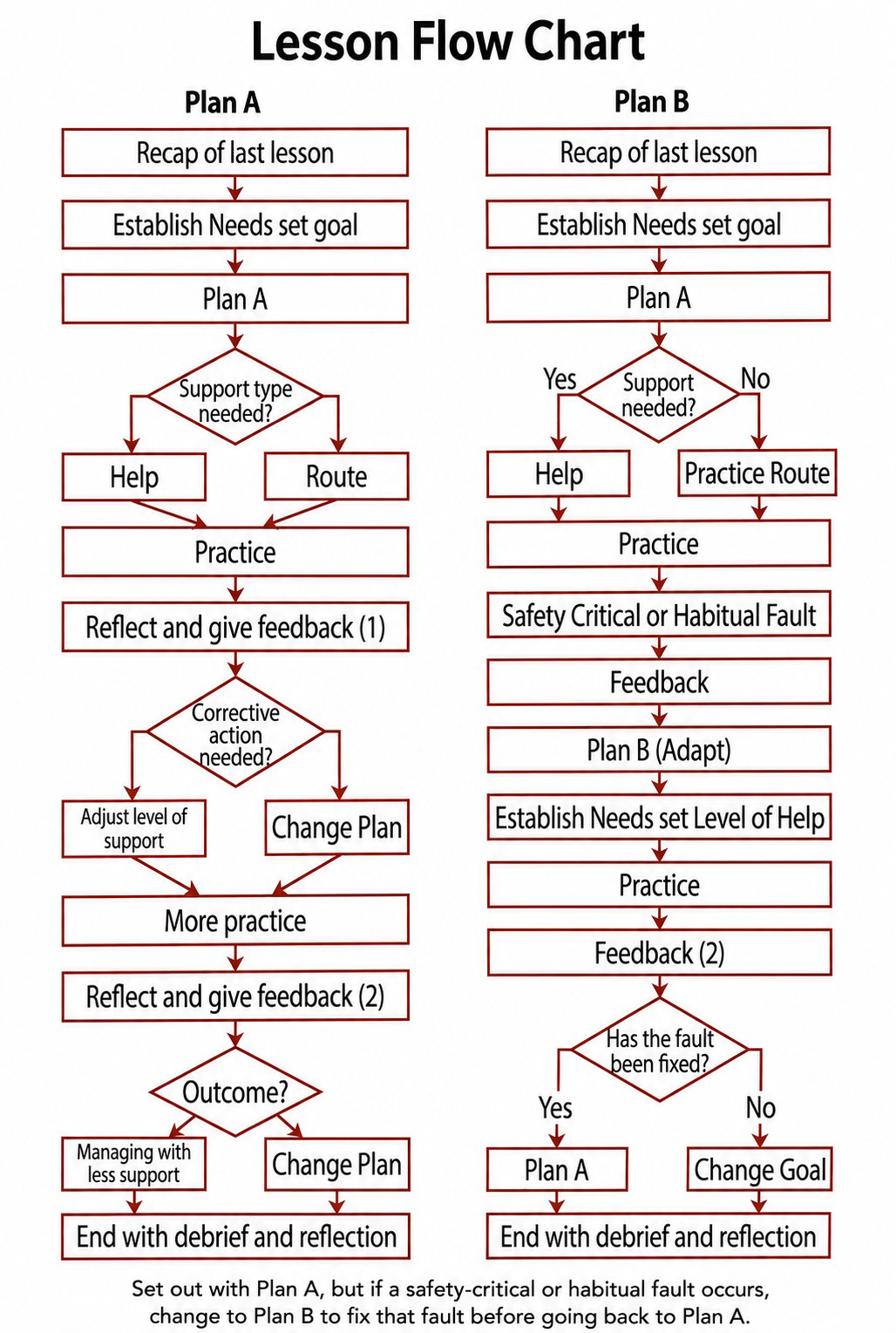
View the Plan A / Plan B Lesson Flow
Remember: not every mistake means the lesson plan needs to change. A minor or isolated error may stay within Plan A, while a safety-critical or habitual fault may mean moving to Plan B.
Different Ways to Prompt
Verbal Prompts
Some pupils respond well to short verbal cues, particularly when they are close to independence and only need a small reminder.
Visual Cues
Some pupils may respond better to a simple visual cue rather than more talking.
- A gesture towards the mirrors
- A glance towards a relevant road sign
These should remain subtle and useful, rather than becoming distracting or effectively giving the answer.
Reflective Prompts
For a pupil who is capable of working the problem out but needs help noticing it, a reflective question may be more appropriate.
Do Not Label the Learner
Avoid deciding that a pupil is simply “a nervous learner” or “a confident learner” and then using the same approach throughout every lesson.
Their needs can change from one situation to another.
Adapt as the Situation Changes
The correct level of prompting at the beginning of a lesson may not remain correct throughout it.
A pupil may perform well on a quiet road and then begin to struggle when traffic increases, the junction becomes more complex or their workload rises.
When the Pupil Is Coping
Reduce the amount of support and give them more opportunity to make decisions independently.
When the Pupil Begins to Struggle
Increase support again if it is needed for learning or safety.

What Would a Good Coach Do?
Two pupils are struggling with meeting traffic on the same narrow road. Both are leaving their decision late.
Pupil A is nervous and becomes overwhelmed when several things happen at once. Pupil B is confident but tends to underestimate how much space is needed.