
When to Change the Plan
A good lesson plan gives direction, but it should never become a script. Effective instructors adapt when the pupil, the risk level or the learning need changes.
The Plan Is a Guide, Not a Script
At the start of the lesson, you may have agreed a clear goal, a suitable route and an appropriate level of support.
That does not mean those decisions must remain unchanged for the full lesson.
As the lesson develops, new information appears. The pupil may progress faster than expected, struggle with something unexpected, become overloaded or reveal a different learning need.
Signals That the Plan May Need to Change
Adaptation should be based on what you observe, not on a desire to simply “cover more” during the lesson.
You may need to change the plan if:
- the pupil is repeatedly making the same error
- the agreed level of support is no longer appropriate
- the pupil is becoming overloaded
- the original goal has already been achieved
- a more important learning need becomes apparent
- risk is increasing beyond the pupil’s current ability
- the pupil’s confidence drops significantly
- the chosen practice is not producing useful learning
When the Lesson Becomes Too Easy
One common problem on the Part 3 test is failing to recognise when the pupil is coping comfortably and the lesson is no longer providing enough challenge.
An instructor may have planned a suitable lesson, chosen an appropriate area and agreed a sensible level of support, but if the pupil quickly demonstrates that they can manage the task with little or no help, the lesson needs to move on.
Continuing with the same level of difficulty for too long can make the lesson look repetitive and may limit the opportunities for the pupil to demonstrate further learning, decision-making and independence.
Increase the Challenge When the Pupil Is Ready
Increasing the challenge does not necessarily mean abandoning the lesson goal. Often, you can keep the same skill but change the environment, level of responsibility or complexity.
Example: Roundabouts
Suppose the lesson goal is improving planning and decision-making at roundabouts, but the pupil is handling the current roundabouts confidently and independently.
Rather than continuing to repeat the same type of roundabout, you might:
- move from quieter roundabouts to busier ones
- progress to roundabouts with higher approach speeds
- introduce multi-lane roundabouts
- use roundabouts where lane choice requires more forward planning
- choose situations with heavier traffic or shorter decision-making time
- reduce the amount of instructor support and increase pupil responsibility
Other Examples
Junctions
Move from quiet junctions with good visibility to busier junctions, restricted views or situations requiring more complex judgement.
Meeting Traffic
Progress from straightforward situations to narrower roads, parked vehicles and situations where several potential meeting points need to be assessed.
Independent Driving
Reduce prompts and allow the pupil to plan further ahead, make route decisions and deal with developing situations independently.
Higher-Speed Roads
Where appropriate to the pupil’s ability, move from lower-speed situations to roads where planning, observation and decision-making need to happen earlier.
Do Not Wait Too Long to Adapt
The Part 3 test is only 45 minutes long, so the timing of your decisions matters.
You do not need to change the plan after one successful attempt, but once there is clear evidence that the pupil is consistently coping with the current level of challenge, you should be thinking about what comes next.
If several successful attempts show that the pupil has achieved what you were trying to develop, continuing with the same task for another ten or fifteen minutes wastes valuable assessment time.
Observe → Confirm → Increase Challenge → Observe Again
This might mean increasing the complexity of the environment, reducing support, giving the pupil greater responsibility or agreeing a natural progression of the original goal.
Changing the Plan Does Not Always Mean Changing the Subject
Sometimes the lesson goal remains exactly the same, but the way you work towards it needs to change.
Change the Support
Increase or reduce prompting, questioning or instruction.
Change the Environment
Move to a quieter or more demanding road depending on the pupil’s needs.
Change the Practice
Break the skill down, repeat a particular element or use a different example.
Change the Goal
If evidence shows that the original goal is no longer the most useful focus, agree a more appropriate one.
Use the Plan A / Plan B Flow
Deciding whether to change the lesson plan is easier when you separate an isolated mistake from stronger evidence that another learning need has become more important.
The Plan A / Plan B flow below gives you a simple way to make that decision.
Use the Plan A / Plan B Decision Flow
Plan A applies when the pupil makes a minor or isolated error and the original learning goal is still appropriate.
Plan B applies when a safety-critical or habitual fault shows that another learning need may now need to take priority.
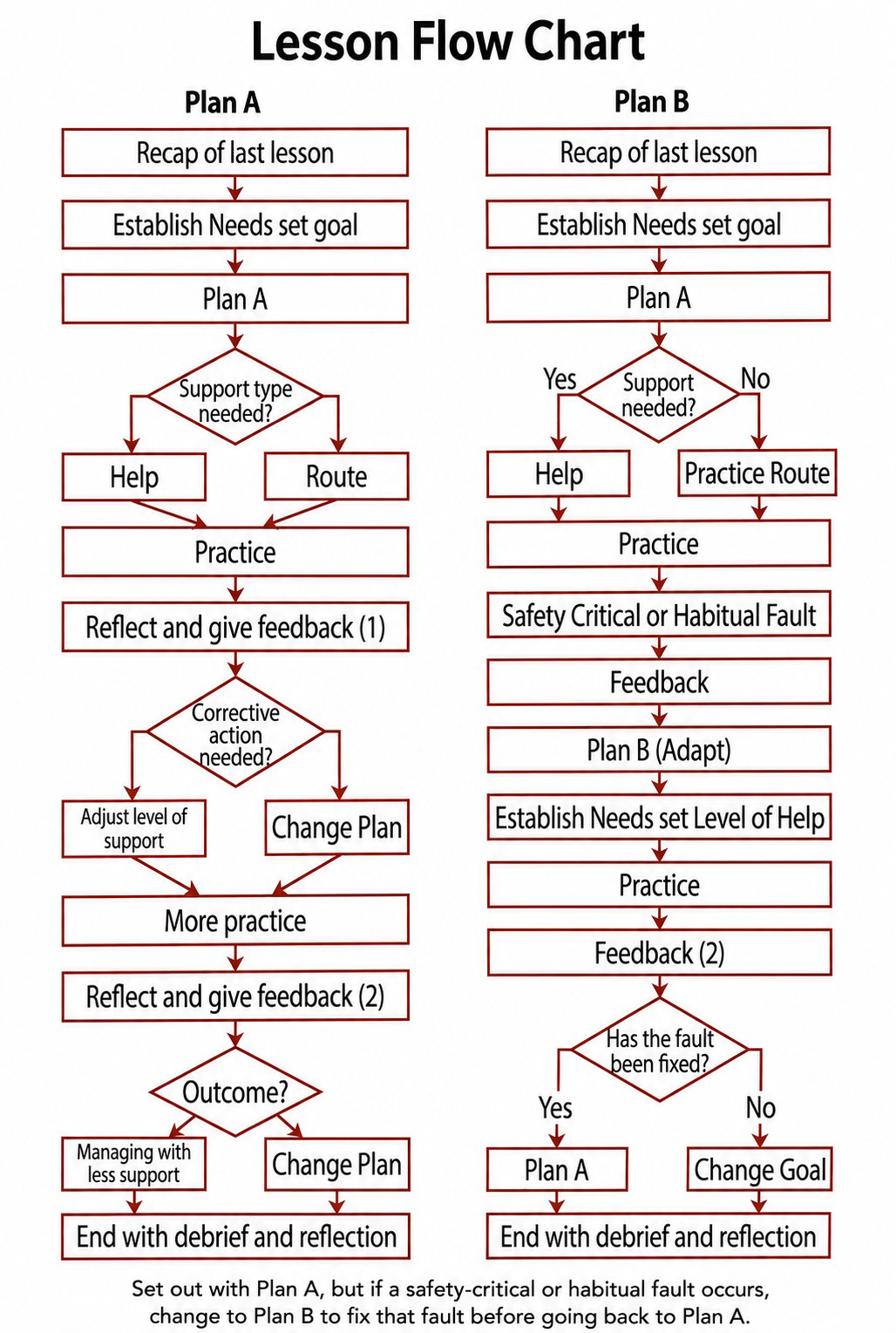
Scenario: The Lesson Is Not Going to Plan
Imagine the agreed goal is improving planning on approach to roundabouts. The pupil initially appears ready for independent practice.
After several attempts, however, they consistently arrive too quickly and their observations become rushed.
The instructor now has choices.
- Continue exactly as planned and hope repetition fixes it.
- Increase prompting and focus specifically on earlier observation.
- Move temporarily to a less demanding roundabout.
- Pause and explore why the pupil is recognising the situation too late.
The strongest response is the one that reflects what the pupil actually needs at that moment.

What Would a Good Coach Do?
Your pupil’s goal is improving planning at roundabouts. You planned to work independently on increasingly busy roundabouts.
After several attempts, the pupil continues arriving too quickly, observations are rushed and repetition is not producing any improvement.
This Is Assessed Throughout the 45-Minute Test
The examiner is not only looking at whether you created an appropriate plan at the beginning of the lesson.
They are observing whether you continue to respond appropriately as the pupil’s performance changes.
- Do you recognise when the current approach is no longer working?
- Do you adapt before the lesson becomes repetitive or unproductive?
- Do you involve the pupil in changes where appropriate?
- Do your changes reflect the pupil’s actual needs?
- Do you check whether the adaptation has improved the learning?
When Would You Change Direction?
Think about a lesson where the original plan stopped working. Did you recognise it early enough, and what evidence did you use to decide what to change?