
After an Intervention: Analysis, Learning & Adaptation
An intervention may solve the immediate safety problem, but the real learning comes from understanding why it happened and what needs to change next time.
The Intervention Is Only Part of the Story
Once the immediate risk has been dealt with, it can be tempting to simply continue the lesson.
But if the pupil does not understand what happened, why it happened and what could be done differently next time, the same problem may simply reappear.
Find the Cause, Not Just the Symptom
The visible fault is not always the real problem.
For example, a pupil may approach a junction too quickly. The obvious fault is speed, but the underlying cause could be:
- late observation
- poor forward planning
- not recognising the junction early enough
- misjudging the amount of time available
- focusing on another task
- becoming overloaded
If the instructor only says “You were too fast there”, the symptom has been identified, but the learning may remain shallow.
Involve the Pupil in the Analysis
The instructor does not always need to provide the answer immediately. Where appropriate, give the pupil the opportunity to analyse the situation.
These questions can help the pupil develop self-awareness and problem-solving skills rather than simply receiving another instruction from the instructor.
After an intervention, the important question is not simply whether the danger has passed. You need to decide what the incident tells you about the pupil’s current learning need.
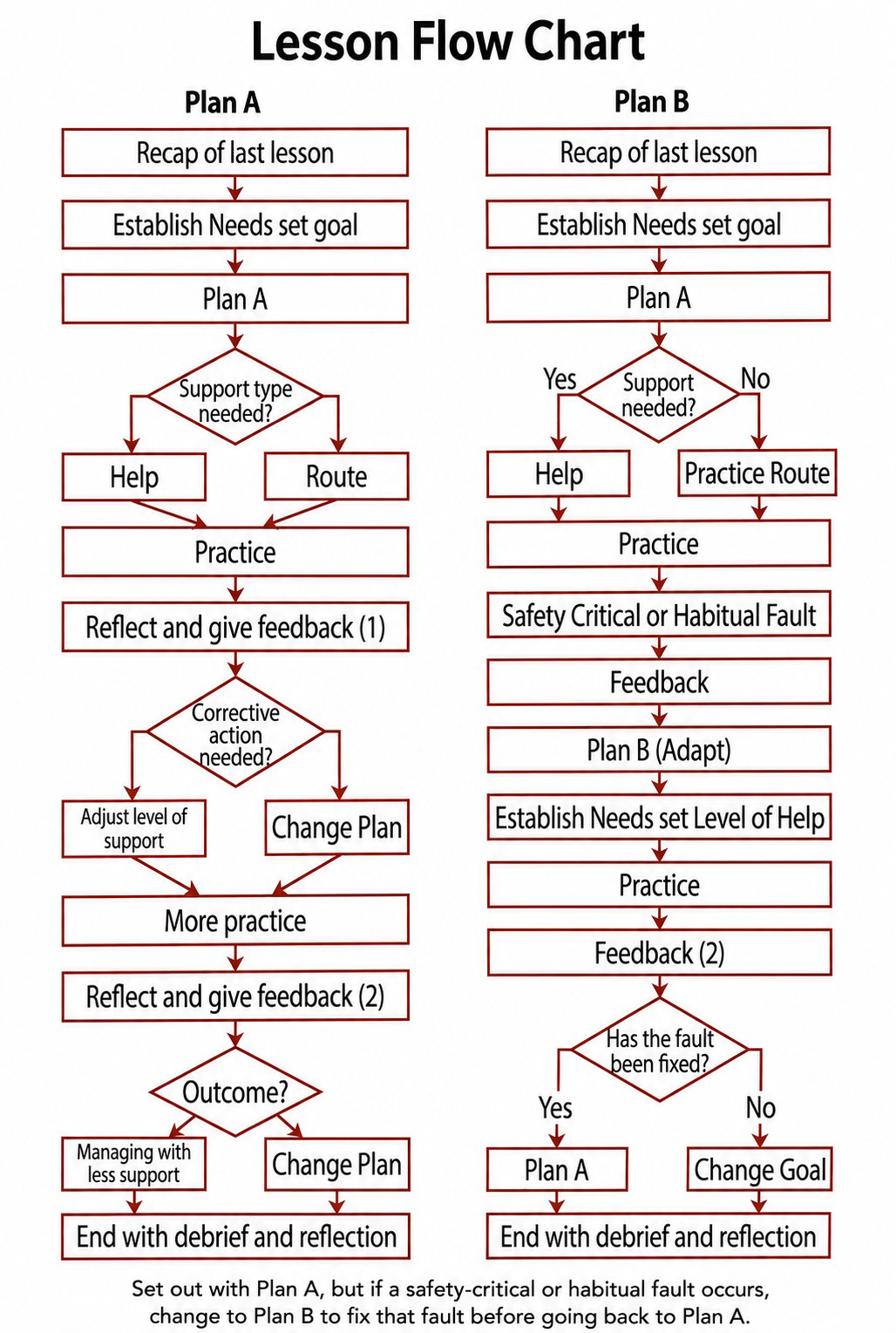
If it appears to be an isolated mistake, the original lesson plan may still be appropriate. If it reveals a safety-critical issue or a repeated pattern, the lesson may need to move to Plan B.
View the Plan A / Plan B Lesson Flow
Remember: not every mistake means the lesson plan needs to change. A minor or isolated error may stay within Plan A, while a safety-critical or habitual fault may mean moving to Plan B.
Use the Analysis to Adapt the Lesson
Once the cause has been identified, decide what needs to change.
After an intervention, the important question is not simply whether the danger has passed. You need to decide what the incident tells you about the pupil’s current learning need.
If it appears to be an isolated mistake, the original lesson plan may still be appropriate. If it reveals a safety-critical issue or a repeated pattern, the lesson may need to move to Plan B.
View the Plan A / Plan B Lesson Flow
Remember: not every mistake means the lesson plan needs to change. A minor or isolated error may stay within Plan A, while a safety-critical or habitual fault may mean moving to Plan B.
Depending on what the analysis shows, adaptation may mean:
- increasing the level of support temporarily
- reducing the complexity of the situation
- changing the type of prompt being used
- giving the pupil more time to plan
- revisiting an earlier skill
- changing the route or environment if the current one is no longer appropriate
- trying the situation again with a clearer strategy
Incident → Analyse → Identify Cause → Decide Plan A or Plan B → Adapt → Practise Again → Review

What Would a Good Coach Do?
Your pupil approaches a junction too quickly and you have to intervene. Once safely through the situation, the pupil says, “I know, I was too fast.”
The same problem has happened twice already during the lesson.
This Is Assessed Throughout the 45-Minute Test
The examiner is not only watching whether you recognise a fault or intervene safely. They are also watching what you do with that information afterwards.
Across the lesson, they may see several opportunities for you to:
- identify why a problem occurred
- involve the pupil in analysing it
- change the level or type of support
- adapt the practice
- check whether the change actually worked
What Did You Do With the Information?
Think of a recent intervention or repeated fault. Did you simply correct it, or did you identify why it happened and change something in the lesson as a result?