
Recognising Repeated Faults & Patterns
One mistake may be just that: a mistake. When the same problem appears again, the instructor needs to start looking for a pattern and asking what is really causing it.
Is It a One-Off Mistake or a Pattern?
Not every mistake needs a lengthy discussion or a change to the lesson. Pupils occasionally make errors for perfectly ordinary reasons.
However, when the same fault appears repeatedly, or similar faults begin to appear in different situations, the instructor should start looking more closely.
A repeated fault may indicate that the pupil has not fully understood the skill, is applying it inconsistently or is struggling with something deeper than the visible error.
The Visible Fault May Not Be the Real Problem
Imagine a pupil repeatedly approaches junctions too quickly.
It would be easy to conclude that the problem is simply speed. But the underlying cause could be:
- looking ahead too late
- not recognising the junction early enough
- poor use of mirrors before slowing
- focusing too heavily on gear selection
- misjudging how much time is needed
- not understanding why earlier planning matters
- becoming overloaded when several tasks arrive together
If you repeatedly tell the pupil to “slow down earlier” without identifying the reason they are late, the visible fault may temporarily improve while the underlying problem remains.
Look for Patterns Across Different Situations
Repeated Late Braking
The pupil may not simply have a braking problem. They may be looking too close to the front of the car and identifying hazards too late.
Repeated Poor Positioning
The issue may not be steering accuracy. It may be poor planning, late observation or uncertainty about where the pupil needs to be next.
Repeated Hesitation
The pupil may understand the rules but lack confidence in judging speed, distance or the intentions of other road users.
Repeated Mirror Omissions
The pupil may know the routine perfectly well but be overloaded because too much attention is being used elsewhere.
If the Fault Repeats, Change Your Approach
If the pupil makes the same error several times and the instructor keeps giving the same explanation or prompt, there is a strong chance that the teaching strategy needs to change.
You might:
- ask the pupil what they think is causing the problem
- change from telling to questioning
- change from questioning to clearer instruction
- break the skill into smaller parts
- use a quieter environment to reduce workload
- change the example or explanation
- increase or reduce the level of support
- revisit an earlier skill that may be contributing to the fault
Observe → Identify Pattern → Explore Cause → Adapt Teaching → Check Improvement
Repeated Faults May Move the Lesson to Plan B
A single mistake may still fit within Plan A. But once the same fault begins to repeat, you have stronger evidence that the pupil may have a genuine learning need that requires a different response.
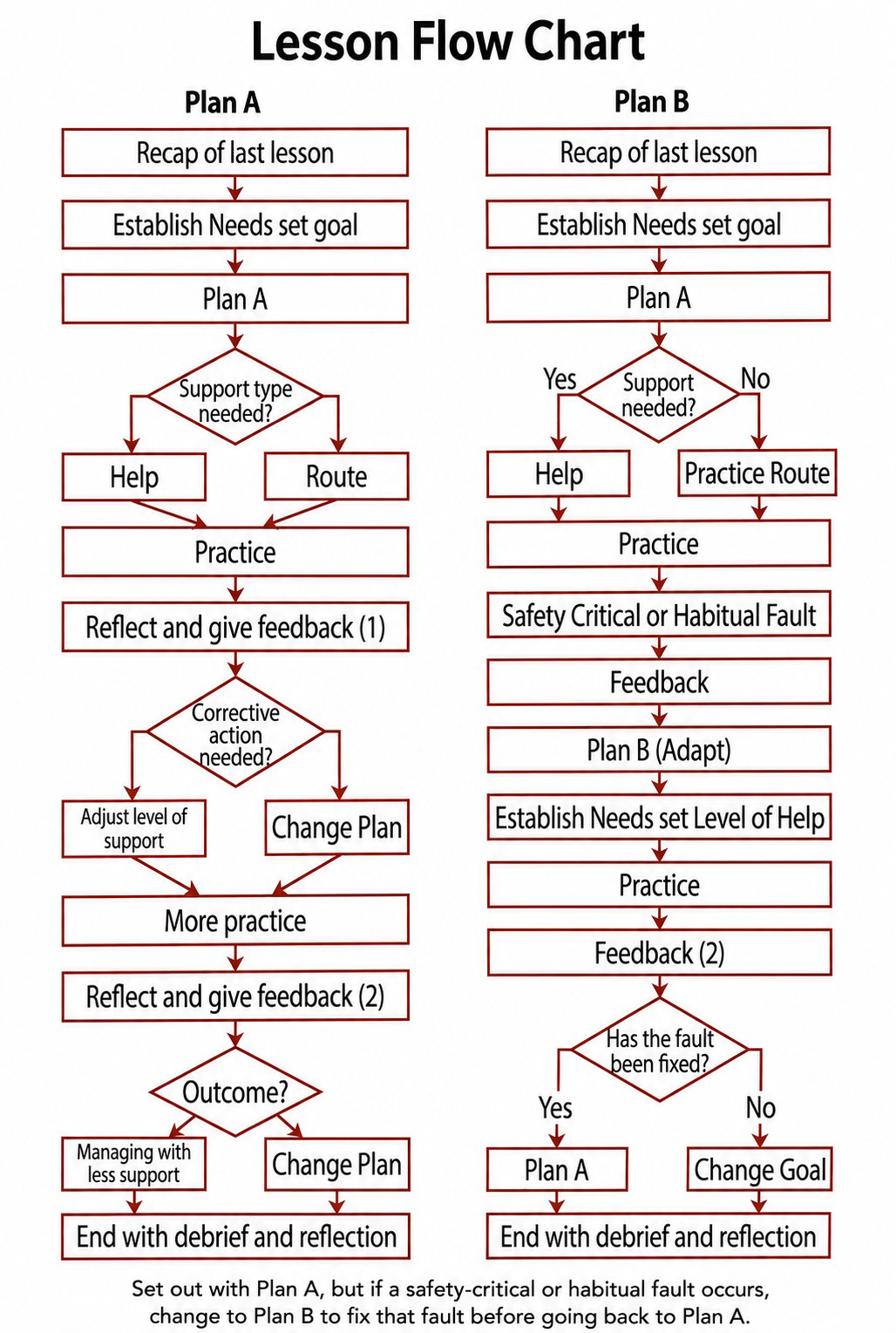
This is where the Plan A / Plan B flow becomes particularly useful.
View the Plan A / Plan B Lesson Flow
Plan A: the error appears minor or isolated, so you reflect, give feedback, adjust support if needed and continue with the original goal.
Plan B: the fault is repeated, habitual or safety-critical, so the evidence may now justify changing the lesson priority.

What Would a Good Coach Do?
Your pupil has approached three junctions too quickly. Each time you have reminded them to slow down earlier.
The same problem happens again on the next junction.
Correcting Faults Without Actually Teaching
A common weakness on Part 3 is an instructor who is very good at spotting faults but does little more than point them out.
You may hear a lesson where the instructor repeatedly says:
The instructor may be accurately identifying what happened, but if the pupil is not being helped to understand why it happened or how to change it, very little real teaching is taking place.
This Is Assessed Throughout the 45-Minute Test
The examiner has the advantage of watching the lesson develop over time. That means they can see whether you recognise patterns rather than treating every fault as an isolated event.
If the same issue appears several times during the 45 minutes, the examiner will be able to see whether you:
- recognise that a pattern is developing
- explore the cause rather than simply naming the fault
- change your teaching strategy
- give the pupil an opportunity to practise the solution
- check whether your intervention actually worked
Because the test is only 45 minutes long, repeated faults need to be recognised reasonably quickly. Spending a large part of the lesson repeatedly correcting the same problem without changing your approach can use up valuable time and provide little evidence of development.
Are You Treating the Fault or the Cause?
Think about a fault that one of your pupils makes repeatedly. What is the visible fault, what might be causing it, and what could you change in your teaching to help the pupil solve the underlying problem?