
Reflection, Adaptation & Independence
Learn how to use reflection to judge whether support should increase, decrease or change, and how to give the pupil a genuine opportunity to demonstrate independent learning.
What Did You Change for the Pupil?
At the end of MODULE 7, you were asked to think about two pupils who responded differently to the same type of instruction.
You were also asked whether you adapted your wording, timing or level of support to suit each pupil.
What did you come up with?
Now take that idea one step further. Once you have adapted your support, how do you decide whether it is actually working?
Why Reflection Matters
Do Not Just Watch the Result
A pupil completing a task successfully does not automatically mean they fully understand what they did or why it worked.
Reflection helps the instructor find out what the pupil understands, what they noticed and whether the current support is still appropriate.
Reflection Can Be Brief
Reflection does not always require a long roadside discussion. A short, well-timed question can give valuable information during the lesson.
- “What helped you get the speed down earlier?”
- “What do you think caused that to become rushed?”
- “How is that level of support working for you?”
Use Reflection to Review the Support
The pupil should be involved in reviewing whether the current level of support is helping them.
Their answer may not always be completely accurate, but it still tells the instructor something important about their understanding and confidence.
If Performance Improves
“That approach was much better. What helped you get the speed down earlier?”
If a Fault Occurs
“We were a bit rushed there. What do you think caused that?”
If Independence Looks Possible
“You managed that with very little help. Ready to try the next one independently?”
Review the Current Support
“How do you feel that level of support is working for you right now?”
Reduce Support When Learning Is Developing
Look for Evidence
If the pupil understands what helped and is applying the skill more consistently, the instructor can begin reducing the amount of support.
The reduction should have a reason. It should not happen simply because the instructor feels they have been talking for long enough.
Agree the Change
Increase Support When the Pupil Needs It
Independence Is Not All or Nothing
A pupil may cope well in one situation and struggle in the next. Increased traffic, a more complex junction or higher mental workload can affect their performance.
If the pupil becomes less consistent or unsafe, the instructor may need to increase support again.
Explain Why
Create Opportunities for Independence
At some point, the pupil needs the opportunity to apply the skill without the instructor continually guiding them.
This is where the instructor can begin to see whether learning has genuinely taken place or whether the pupil was simply following prompts.
Silence Can Be Part of the Teaching
Step Back
Once prompts have been reduced and the pupil is coping well, the instructor can deliberately step back and allow them to manage the situation independently.
Reflect Afterwards
The reflection helps confirm whether the pupil understands what made the attempt successful.
Do Not Give Responsibility Then Take It Back
The Contradiction
A common mistake is agreeing that the pupil will take more responsibility and then immediately talking them through every stage.
The words say the pupil has responsibility, but the instructor has actually taken control back.
A Better Agreement
Then give the pupil a genuine opportunity to carry out that agreement.
Reflect, Adapt, Test Independence
This cycle can happen several times during one lesson.
The instructor is continually asking whether the support is still appropriate and whether the pupil is taking enough responsibility.
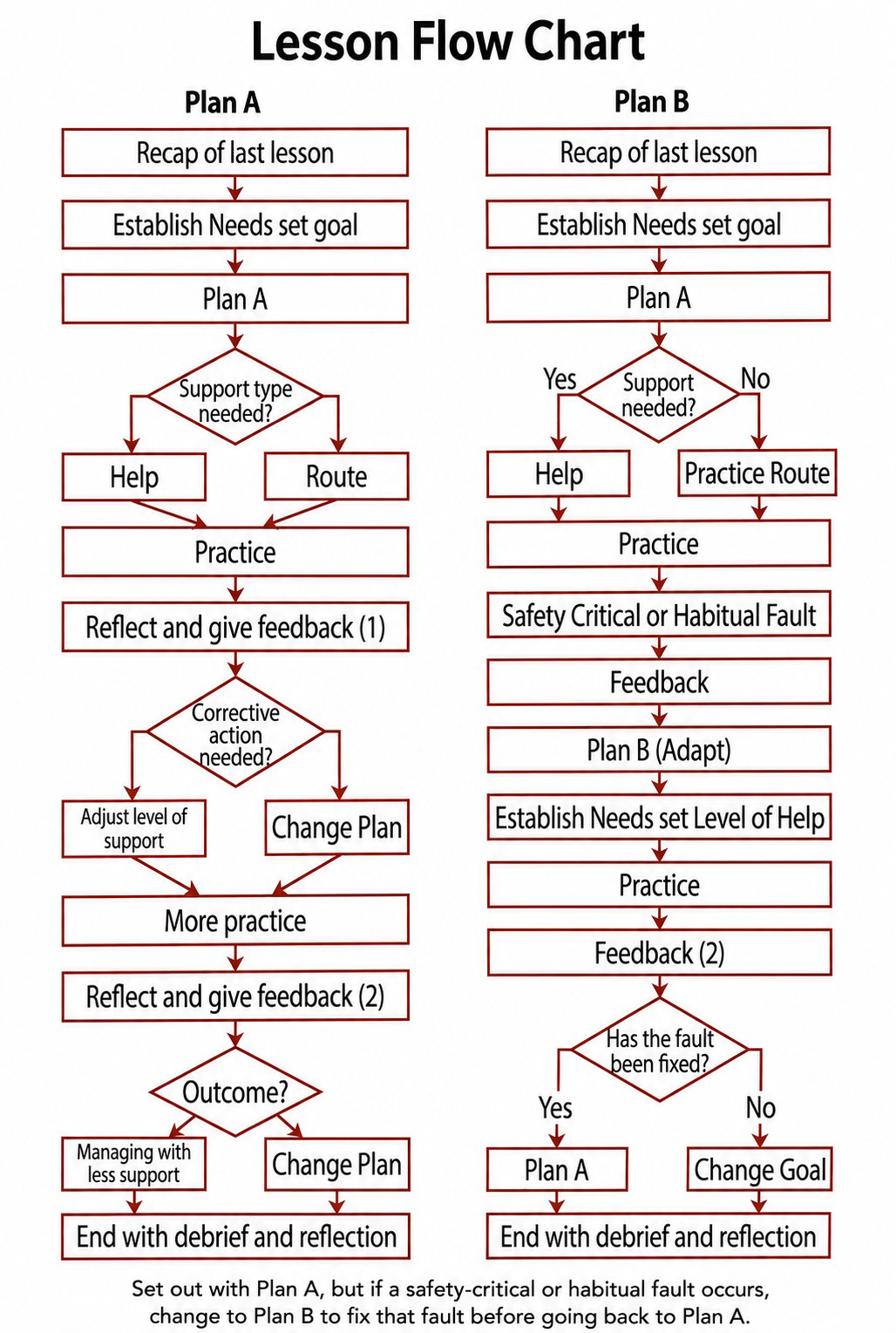
Reflection should lead to a decision. Sometimes the pupil simply needs a little more or less support within the original lesson plan. At other times, the evidence may show that the lesson needs to change direction.
View the Plan A / Plan B Lesson Flow
Not every mistake means the lesson plan needs to change. A minor or isolated error may stay within Plan A, while a safety-critical or habitual fault may mean moving to Plan B.

What Would a Good Coach Do?
Your pupil has completed several junctions successfully with only light prompting. After reflecting together, you agree that they will deal with the next junction independently.
As the next junction approaches, the pupil has not yet started reducing their speed. There is still enough time for them to recognise the situation and act safely.
Before You Move On
Think about a recent lesson where the pupil was performing well with your support.
Did you deliberately create an opportunity for them to try the same skill independently, or did you continue prompting because the lesson was going well?
How could you use a short reflection next time to decide whether it is time to step back and let the pupil prove what they can do?
↑ Back to top